

Is cutting-edge research enabled by collaboration between a supercomputing network and an AI agent already a reality in China?
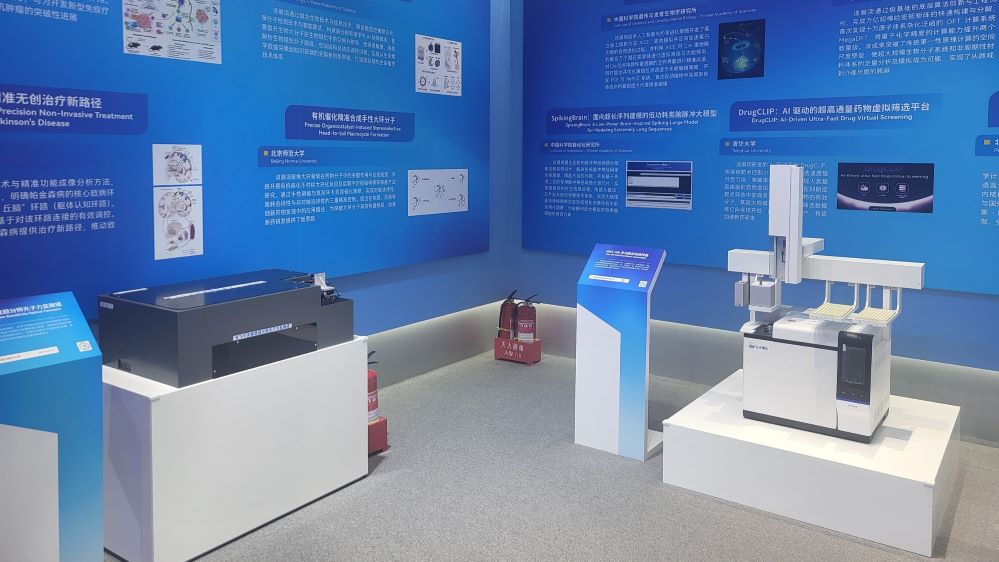
At the end of 2025, two systems were introduced in China with the aim of accelerating the use of artificial intelligence in scientific research. The first is a large-scale distributed computing network that connects supercomputing centers in dozens of cities into a unified system. The second is an AI agent capable of planning and carrying out various research tasks semi-autonomously. On paper, the combined use of these systems has the potential to significantly speed up and strengthen research work, but so far claims about their performance and benefits are based solely on state-controlled Chinese media sources. The truth may remain uncertain.
In late 2025, China unveiled two systems designed to advance the use of AI in scientific research. The first is a massive distributed computing network, the so-called Future Network Test Facility (FNTF; in some sources also Future Network Experimental Facility, FNEF). FNTF/FNEF is part of China’s broader “Eastern Data, Western Computing” (dongshu, xisuan) initiative, which aims to relocate data centers to the western parts of the country, where they are cheaper to operate. The facility connects China’s top-tier computing centers and spans 40 cities via an optical network stretching over 55,000 kilometers. The network functions like a massive supercomputer, enabling highly demanding real-time applications. Data transfer through the network is significantly faster than over the conventional internet: in tests, for example, transferring a massive radio astronomy dataset took less than two hours, whereas previously the same operation would have taken well over a year. In addition to its impressive performance, the network is also quite efficient economically, reportedly achieving about 98% of the efficiency of a single data center. According to commentators, the network offers significant time and cost savings, allowing China’s distributed supercomputing centers to function as a unified whole rather than separate units, thereby accelerating the country’s development of AI and advanced technologies. The benefits of FNTF/FNEF are seen especially in training large AI models.
It is precisely this synergy that the “National Supercomputing Internet Scientific Computing Intelligent Agent” (Guojia chaosuan hulianwang kexue jisuan zhinengti), launched in the city of Tianjin, seeks to leverage. This system combines China’s latest AI expertise with high-performance computing resources and allows users to interact with it using natural language. Under user guidance, the system can perform various research-related tasks, such as breaking down research problems into parts, scheduling computing resources, using research software, analyzing results, and producing reports. Media coverage has emphasized that the project represents a shift from “computational science to intelligent science”, i.e. AI functioning not merely as a tool for researchers but as an active participant in the research process. Impressive figures have also been reported about the AI agent’s performance: it is said to be able to complete in one hour a workload that previously required a full day, allegedly without continuous human supervision. Although the system is currently optimized for only certain research fields, efforts are reportedly underway to expand its applications in the future. At present, more than 1,000 organizations have access to the system.
Foreign commentators have suggested that if the claimed efficiency holds true in real-world workloads, it would signify a significant breakthrough in distributed supercomputing, and that combining such computing power with AI could substantially accelerate scientific discoveries. However, major uncertainties remain. All user experiences and performance claims currently rely solely on Chinese, largely state-controlled media sources. For example, the widely repeated claim of 98% efficiency originates directly from statements by Liu Yunjie, an engineer at the Chinese Academy of Sciences and leader of the project, published in the state-run Science and Technology Daily journal. This figure has since been echoed in foreign media without independent verification. As of now, there are no publicly available external user experiences or peer-reviewed studies on the network’s performance. It remains unclear, for instance, whether the network can maintain high efficiency under continuous use, how it withstands fluctuations in the power grid, disruptions, and cybersecurity threats, or what the actual energy consumption is when dozens of data centers operate together. It remains to be seen whether satisfactory answers to these questions will ever emerge. Given that these systems could, if functional, offer significant strategic advantages not only for civilian but also for military R&D, it is evident that China may not have strong incentives to allow independent external evaluation and testing.
Olli Suominen
olli.suominen(at)gov.fi