History in the hands of today’s learners
Satakunta Museum showcases 3D models of prehistoric artefacts for educational use
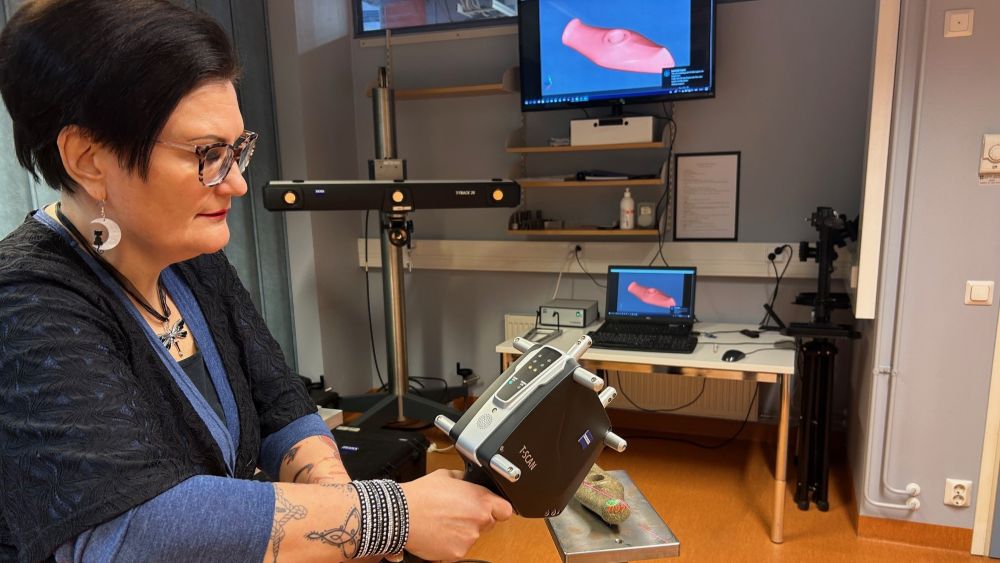
Satakunta Museum is digitising its prehistoric collections into three-dimensional format as part of the European Twin it! campaign. The project, funded by the Ministry of Education and Culture, aims to improve access to cultural heritage by presenting historical objects to a wider audience, and by supporting education and research through digital solutions.
Satakunta Museum is participating in the Twin it! campaign led by the European Commission and Europeana, under which EU Member States produce high-quality 3D digital representations of their cultural heritage for inclusion in a shared European cultural heritage data space.
As part of the 3D digitisation project, 20 archaeological artefacts dating from the Stone Age to the Iron Age have been selected. These include tools, weapons, amulets and wooden objects. Together, they offer insights into everyday life thousands of years ago, with digital modelling enabling more accessible engagement with this history.
3D models to support teaching
the use of 3D‑printed artefacts, students are able to explore form and weight, experiment with ancient tools in a safe way, and take part in learning activities involving storytelling, soundscapes, light, movement and imagination. The production of physical replicas enables the study of artefacts in multisensory detail without the need to handle any original objects.
The digital 3D models are published openly online on the Sketchfab platform, as well as through the services provided by Finna and Europeana. Each model is accompanied by clear printing instructions, allowing for use with a wide range of 3D printers and supporting application in various educational settings.
The digitisation work is carried out in close collaboration with the Department of Mechanical and Materials Engineering at the University of Turku. The University contributes engineering expertise to the project and provides access to high‑resolution 3D scanners and 3D printing facilities.
The project forms part of a broader objective to improve access to cultural heritage and to explore new ways of learning from prehistory. By creating 3D models and physical printouts based on them, students are able to examine and handle the objects directly, supporting school‑level education and supporting young people’s interest in history. In addition, workshops will be organised as part of the project. These workshops combine history with modern technologies and encourage students to experiment with 3D modelling and printing as part of their learning process.
Europeana serves to support teaching and workshops
Besides the 3D models of the prehistoric items at Satakunta Museum, Europeana offers a wide range of cultural heritage assets from Finnish libraries, archives and museums. They can be used in teaching, workshops and digital learning environments as part of our European cultural heritage.
Inquiries: Tapani Sainio, Senior Ministerial Adviser, tel. +358 295 330336
Read more
Satakunta’s Prehistory in Three Dimensions
Explore the data space
Europeana